
Bee & Wasp Removal in Tempe, AZ
- Pest Control Service in Tempe
- Bark Scorpion Treatment
- Scorpion Sealing & Exclusion
- Subterranean Termite Treatment
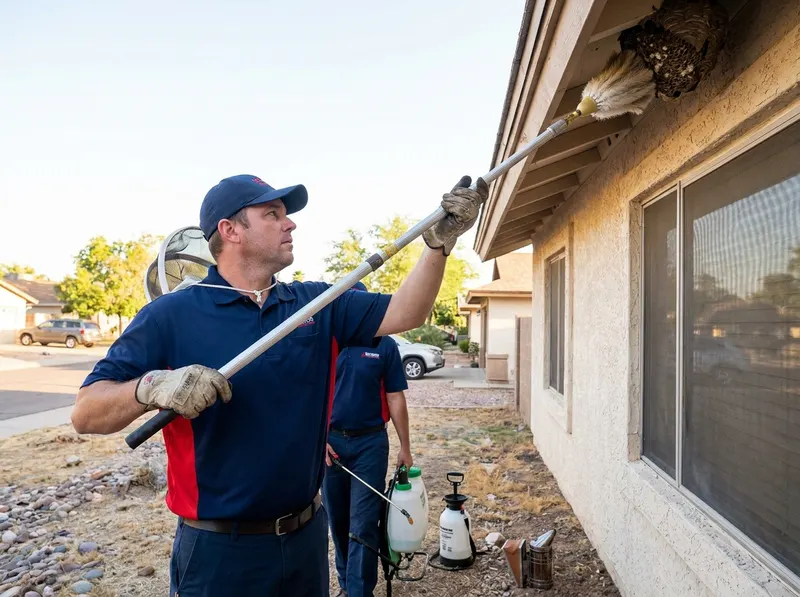
- Included: on-site species ID (honey bee vs. paper wasp vs. yellowjacket), treatment or removal of the active nest, knockdown of the nest material where reachable, and written scope listing what was treated and where.
- Speed: swarms and aggressive wasp nests are triaged as urgent because they involve a sting risk; call (520) 677-3740 for the soonest available window, typically same-day or next-day.
- Cost: most Tempe bee and wasp jobs run $250 to $500; hives established inside a wall, roof or chimney void run higher because carpentry and comb removal are involved.
- Minimum charge is $250 for any bee or wasp visit in Tempe, including a single accessible nest under an eave.
- Re-entry and safety: you get a clear re-entry time for people and pets before we leave, plus a note on which windows, patio doors and pool areas to keep closed during and after treatment.
- Booking: call or text (520) 677-3740 with a photo from a safe distance and the location — eave, block wall, valve box, palm, water meter, chimney — and we quote a range on the phone and confirm the exact price on-site before work starts.
Timing is the whole diagnosis in Tempe. Spring swarming runs heavy from roughly March into May, when honey bee colonies split and a football-sized cluster lands on a mesquite branch, a patio umbrella, a citrus tree in Maple-Ash or the top of a block wall in Warner Ranch. <strong>A swarm hanging in the open with no comb built yet is a different job than a colony that has been inside a wall for months.</strong> Swarms often move on within a day or two on their own; the risk is that they choose a cavity on your house instead. Established colonies do not move on, and they leave behind comb and honey that stains drywall, attracts roaches and ants, and draws new bees to the same scent. If someone offers to just spray the entrance and walk away, understand the trade-off: the bees die, the comb stays, and the honey ferments inside your wall.
Where colonies actually set up in Tempe follows the building stock. Irrigation valve boxes and water meter boxes in Mitchell Park and Optimist Park yards are frequent ground-level cavities. Unskirted palm trunks around The Lakes and Escalante hide both honey bee colonies and wasp nests inside the dead frond skirt. Older stucco homes near the Arizona State University Tempe campus and the Mill Avenue District give bees access through gaps at weep screeds, unscreened attic vents, chimney chases and the void above a bay window. In Dava/Superstition, Hudson Manor, Alta Mira and the Corona del Sol area, block-wall cap voids and shared wall cavities between neighbors are common enough that we check the far side before quoting. <strong>Removal from a structural void is quoted separately from spraying, because it involves opening a surface, extracting comb, and sealing the entry.</strong>
Wasps are a lighter job and a faster call. Paper wasp umbrella nests under eaves, patio covers, ramadas and grill lids build through the warm months and surge after monsoon storms push insect activity up. Mud daubers on stucco walls are largely non-aggressive and mostly a cosmetic issue. Yellowjackets and ground nests near turf and irrigation — the sort of thing that turns up along canal-path yards and near park-adjacent lots by Kiwanis Park — are the ones worth treating quickly, because they defend a wide radius and sting repeatedly. <strong>If the nest is above single-story reach, on a tile roof, or inside a wall, that is ladder or access work and belongs in the written scope, not a phone guess.</strong>
On honey bees specifically: Arizona public-health guidance treats feral honey bee colonies in Maricopa County as potentially Africanized, which is why we do not recommend homeowner spray cans, garden hoses or smoke on an established hive. Defensive colonies escalate. <strong>Keep 20 feet away, move pets and kids indoors, and close nearby doors and windows until it is handled.</strong> When a swarm is fresh, accessible and calm, live relocation by a beekeeper can be the better outcome, and we will tell you when that is the case rather than treating by default. <strong>You will always get the scope in writing — what was treated, where, the re-entry time, and whether exclusion work is still open.</strong> Pool decks, vegetable beds and pet water bowls get called out specifically in the plan for that property.
One honest note on price. A phone number can only produce a range, because the cost driver is access: a nest under a low eave is straightforward, while a colony behind stucco on a second story is carpentry. <strong>The range you hear on the phone is a ballpark; the exact number is confirmed on-site before anyone opens a container or a wall.</strong> Small landlords with ASU-area rentals can have the scope and price sent in writing before a tenant visit is scheduled.
Call (520) 677-3740Bee & Wasp Removal pricing in Tempe
| Exposed honey bee swarm cluster (tree, patio, block wall, single-story reach) | $250 – $425 |
| Paper wasp nest treatment, accessible eave, patio cover or grill area | $250 – $350 |
| Multiple wasp nests or two-story / roof-level access requiring ladder work | $325 – $550 |
| Ground or box nest (irrigation valve box, water meter box, turf-edge yellowjackets) | $250 – $425 |
| Established honey bee colony inside wall, roof, chimney or bay-window void | $550 – $1,500+ (access-dependent) |
| Comb and honey cleanout plus entry sealing after colony removal (quoted separately) | $300 – $900 |
| Palm skirt colony or nest removal including frond clearing for access | $350 – $750 |
| Minimum charge, any bee or wasp visit in Tempe | $250 |
Exact price confirmed free on-site before any work.
Bee & Wasp Removal — questions, answered
How fast can you get to a bee swarm in Tempe?
Bee swarms and aggressive wasp nests in Tempe are triaged as urgent sting-risk calls, and we aim for same-day or next-day arrival depending on the schedule when you call (520) 677-3740. Send a photo from at least 20 feet away and tell us the exact location — eave, palm, valve box, block wall or chimney — so the right access equipment is on the truck.
What does bee removal cost in Tempe, and why the wide range?
Most bee and wasp jobs in Tempe fall between $250 and $500, with a $250 minimum for any visit. The range widens for established colonies because cost is driven by access: a swarm on a citrus branch in Maple-Ash is quick, while a hive behind stucco on a two-story house near the ASU campus requires opening the surface, removing comb and sealing the cavity. You get a range on the phone and the exact price confirmed on-site before work begins.
Are bees relocated live or treated in Tempe?
Fresh, accessible swarms in Tempe are sometimes good candidates for live relocation by a beekeeper, and we will say so when that is the better path. Arizona public-health guidance treats feral honey bee colonies in Maricopa County as potentially Africanized, so established defensive colonies inside a structure are handled as a safety problem first rather than a relocation project.
Is the treatment safe around kids, pets, pools and garden beds in Tempe?
Every Tempe bee and wasp job comes with a stated re-entry time and a written note on where product was applied. Before we start, we identify pool decks, vegetable beds, pet bowls and patio furniture on that property and plan placement around them, and we tell you which doors and windows to keep closed during and shortly after treatment.