
Subterranean Termite Treatment in Tempe, AZ
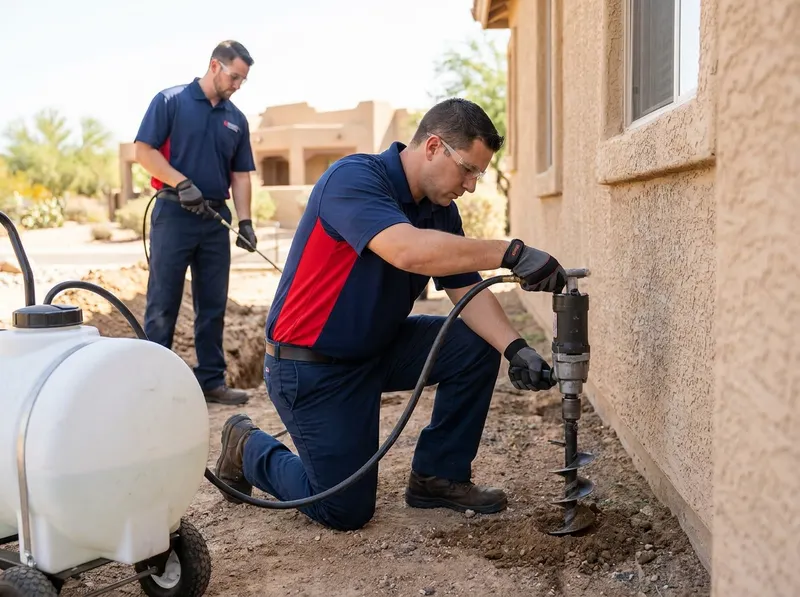
- Included: inspection of the full foundation perimeter, block walls and garage joints; a written graph of where activity was found; trenching and rodding of soil, plus slab or patio drilling where termites are entering through concrete; mud tubes knocked down and re-checked.
- Speed: inspections in Tempe are usually scheduled same or next business day, and most single-family perimeter treatments are completed in one visit of roughly 3 to 6 hours.
- Cost: localized treatments start at a $250 minimum; whole-perimeter liquid treatments on typical Tempe homes commonly land in the $900 to $2,400 range depending on linear footage and how much concrete has to be drilled.
- Payment: card, check, or cash, taken after the scope is signed — no deposit is required to get an inspection and written quote.
- Booking: call or text (520) 677-3740 with your cross streets and what you found (mud tubes, swarmers, hollow trim), and the inspection slot is confirmed with a price range before anyone drives out.
The diagnosis matters more than the chemical. Pencil-thin mud tubes climbing a block wall, a dirt-packed crack in the garage slab, or drywall that dents under a thumbnail all point to subterranean activity; small dark swarmers on a summer evening after a monsoon rain point to a mature colony already established nearby. Drywood damage, carpenter bees, and old inactive tubes get mistaken for live infestation constantly, so the inspection comes first and the <strong>written graph shows exactly where activity was found and where treatment is proposed</strong> before any equipment comes off the truck.
Tempe geography drives where these colonies show up. Older Maple-Ash and Mitchell Park properties near the Arizona State University Tempe campus tend to have decades of added patios, additions, and slab pours, and every cold joint between two ages of concrete is a potential highway. Warner Ranch, The Lakes, and the Corona del Sol area lean toward slab-on-grade construction with drip irrigation and turf pressed close to the stem wall — consistently damp soil at the footing is the single most common condition we find behind repeat activity. Dava/Superstition, Escalante, Hudson Manor, Alta Mira, and Optimist Park all have miles of shared block wall, and a footing that runs from your yard into the neighbor's is a shared foraging route. Anywhere stucco extends down past the weep screed to touch dirt, termites get a hidden entry the eye never sees.
Liquid termiticide versus a bait system is the real decision. <strong>A full perimeter liquid treatment is the faster route</strong> when there is active feeding inside the structure and the soil is accessible: it puts a treated zone in place the day it is applied. Baiting suits properties where trenching is impractical — heavy hardscape, pool decking to the stem wall, mature landscaping you do not want disturbed — and it works by eliminating foragers over months rather than in an afternoon. The trade-off is honest: <strong>liquid is quicker and usually cheaper per foot; bait is less invasive but takes time and requires monitoring visits</strong>. Spot treatment of one wall or one joint costs least and is legitimate for a small, clearly isolated point of entry, but it is not a whole-house barrier and we will say so in writing rather than let you believe otherwise.
Safety and access get answered before, not after. Termiticide goes into soil and into drilled holes at the base of walls, not misted around living space; <strong>interior drill holes are patched and treated soil is covered before we leave</strong>, and re-entry to treated rooms is generally same-day once the work area is closed up. Tell us where the vegetable beds, dog runs, and pool equipment are and those areas get planned around or handled differently. Irrigation timers, grade against the stem wall, and wood-to-soil contact are called out as separate recommendations — <strong>correction work is quoted apart from the treatment itself</strong>, never bundled to inflate a number. Every price is a ballpark until the perimeter is measured; the exact figure comes from the free on-site inspection, in writing, with no contract required to move forward.
Call (520) 677-3740Subterranean Termite Treatment pricing in Tempe
| Localized / spot treatment — one wall run, garage expansion joint, or short block-wall section | $250–$600 |
| Full perimeter liquid termiticide — home under roughly 1,600 sq ft | $900–$1,700 |
| Full perimeter plus slab and patio drilling — larger Warner Ranch or Corona del Sol-area homes | $1,400–$2,400 |
| In-ground bait station system installed around foundation | $1,000–$2,000 plus monitoring visits |
| Patio, driveway, or room-addition cold-joint treatment | $350–$800 |
| Follow-up monitoring or re-inspection visit after treatment | From $250 |
| Foundation inspection with written graph and scope | No charge, on-site |
Exact price confirmed free on-site before any work.
Subterranean Termite Treatment — questions, answered
How do I know the mud tubes on my Tempe block wall are active?
Active tubes in Tempe rebuild themselves. Break a one-inch section out of the tube, leave it a few days, and if the gap is packed back with damp soil the colony is still foraging that route. Sealed-over or dry, crumbly tubes with no repair usually indicate old activity — but the wall still gets inspected on both sides of the footing, since shared walls in neighborhoods like Escalante and Optimist Park carry termites between properties.
When do subterranean termites swarm in Tempe?
Desert subterranean termites in Tempe most often swarm on humid evenings during the monsoon months of roughly July through September, frequently the night after a rain. Small dark winged insects around exterior lights or discarded wings on a patio near Tempe Town Lake or Kiwanis Park indicate a mature colony in the area, not necessarily inside your walls — an inspection separates the two.
Will you have to drill inside my Tempe home?
Sometimes, and only where termites are entering through concrete. In Tempe slab-on-grade homes common to Warner Ranch and The Lakes, entry often occurs at plumbing penetrations, cold joints, and cracks, which requires small holes drilled at the base of the wall or through the garage slab. Holes are patched before we leave, and the graph you sign shows every planned drill location in advance.
Is termite treatment safe around kids, pets, pools, and a backyard garden in Tempe?
Termiticide is applied into soil at the foundation and into drilled holes, not fogged through living areas, so exposure is limited to the treated ground. Tell us where the pool equipment, dog run, and vegetable beds are and those zones get planned around or handled with a different approach. Re-entry to treated rooms is generally the same day once holes are patched and soil is covered, and we give you the product name and re-entry guidance in writing.